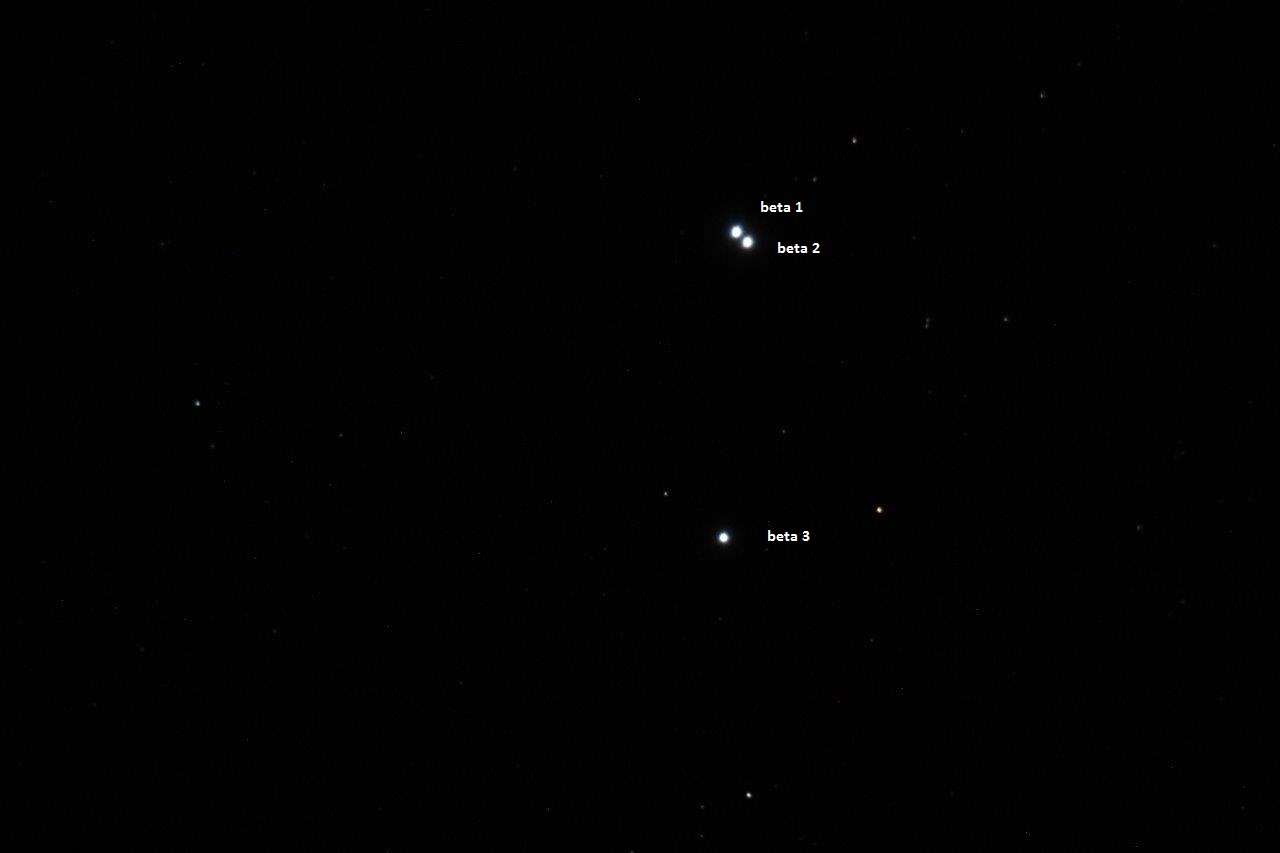
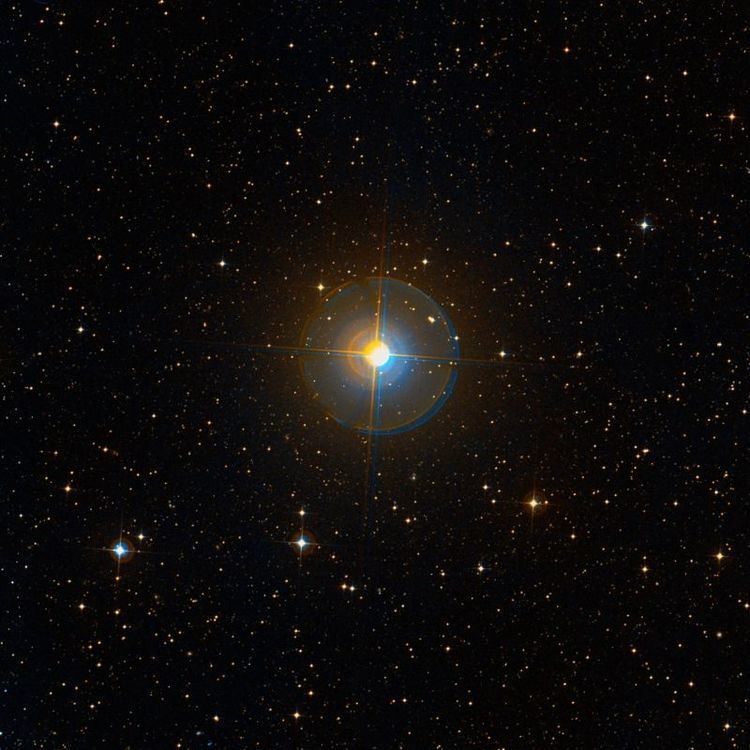
Beta Tucanae, Latinized from β Tucanae, is a group of six stars which appear to be at least loosely bound into a system in the constellation Tucana. Three of the stars are luminous and distinct enough to have been given their own Bayer designations, β1 Tucanae through β3 Tucanae. The system is approximately 140 light years from Earth.
β1, 2 Tucanae
The two brightest stars, Beta1 Tucanae and Beta2 Tucanae, also referred to as Beta Tucanae A (or AB) and Beta Tucanae C (or CD), are 27 arcseconds, or at least 1100 astronomical units (AU) apart. They are both main sequence dwarfs, Beta1 a blue-white B-type star with an apparent magnitude of 4.36, and Beta2 a white A-type star with an apparent magnitude of 4.53.
Both of these bright stars are binaries. Beta Tucanae B is a magnitude 13.5 star which is a close companion to Beta1, being 2.4 arcseconds, or at least 100 AU away. Beta2's companion, the 6th magnitude Beta Tucanae D, is another A-type star which is separated by approximately 0.38 arcseconds (16 AU) from Beta2.
β3 Tucanae
Beta3 Tucanae is a suspected binary star which is separated from Beta1 and Beta2 Tucanae by 9 arcminutes on the sky, which puts the two systems at least 23 000 astronomical units (AU) or 0.37 light years apart. It is not clear how tightly Beta3 Tucanae is gravitationally bound to the rest of the β Tucanae system, but all the stars have similar distances from Earth and have the same proper motion on the sky, indicating they are gravitationally influencing each other to some degree.
In 1926, Beta3 Tucanae was reported to be a binary, with two components of magnitudes 5.7 and 6.1 separated by 0.1″, although more recent observations could not confirm this. At the separation of 0.1″ they would be separated by at least 4 au.
Beta3 Tucanae has an infrared excess, suggesting the presence a debris disk around the primary star.
β Tucanae system
Beta1a's binary companion, Beta1b, orbits at a bit over three times Neptune's distance from the Sun. The Beta2 pair is located over ten times further away. The pair is separated by less than the distance from the Sun to Uranus. The Beta3 pair is much further out, at one-and-a-half times the distance of Proxima Centauri from the main Alpha Centauri pair. The Beta3 pair are separated by less distance than the Sun and Jupiter.
References